A home-run in queer media: A League of Their Own 2022
A product of the modern-day ‘woke’ agenda or a perfect example of meaningful representation? Abby Rampling explores how A League of Their Own (2022) does diversity right.

by Abby Rampling
Oct 28, 2025

Set in the 1940s, the sports-comedy follows the Rockford Peaches, a team in the first professional female baseball league. Will Graham and Abbi Jacobson expertly navigate a variety of discriminatory behaviour which was present at the time. Not only exploring the misogyny that the players faced but also racism, homophobia and transphobia. It’s not all as doom and gloom as it sounds, as A League of Their Own (ALOTO) approaches difficult topics by highlighting the support systems around the characters that face them. It’s a complex, heartwarming series of friendship, self-acceptance and an overarching message of tolerance. On paper, the show sounds like a tick-box exercise, but the way these storylines intertwine is something that creates harmonious representation that doesn’t feel so by the book; these characters have depth.
The plot follows two main storylines, the first explores Carson Shaw’s experience with the Peaches. Based on the real All-American Girls Professional Baseball League founded in 1943, the fictional characters experience many of the very real problems at the time. Homophobia was rife as assumptions tainted the girls’ public reputations and harassment was common. ALOTO illustrates how in the face of adversity, bonds can strengthen, and people can grow closer, like the original Rockford Peaches. The audience can feel the camaraderie through the screen, and it is exactly the kind of media that should be in production in this age of the Lionesses, Ilona Maher and Coco Gauff. Women in sports have never been louder.

The second storyline comes after Max Chapman, a black pitcher, is rejected from try-outs for not being ‘all-American’. Her story highlights the racism still prevalent in America at the time, despite the Roosevelt Order, and the many barriers women of colour face trying to get into sports. While the show is set in America, there is also an ethnicity gap in the UK to this day, with black British girls shown to be 11% less active than white British girls according to Women In Sport. Max’s story of perseverance and the benefit of strong female friendships is so important in today’s society. Women in sport are finally in a safer position to be pushing back against injustices and her legacy as a character inspires young girls to continue this. She also questions her gender expression which causes tension in her relationship with her religious mother. The ambiguity of her gender is pertinent in our current society of labels, but it is important to realise the discrimination she faces in ALOTO is not uncommon today.
The show is filled with so many important messages and is a must-watch. It speaks about tolerance through characters that the audience grows to care for and reminds us not only how far women’s sports has come, but also how far it still has to go.
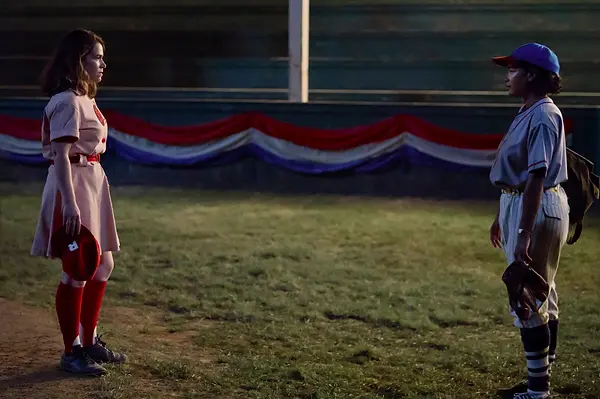
The star-studded cast includes actors from The Good Place, Parks and Recreation, and You. While most of the performance was moving and impactful, there were some places where delivery was unconvincing, which is not uncommon with period-accurate scripts. This was not the case for Vida actress, Roberta Colindrez, her performance as Lupé was astounding. Transforming a seemingly ignorant, self-obsessed pitcher into a lonely team player just looking to be accepted by the end of the series was no mean feat, but she portrayed it effortlessly. Molly Ephraim was irreplaceable as Maybelle, with impeccable comedic timing and the chemistry between Chanté Adams and Gbemisola Ikumelo was addictive to watch.
The all-female ensemble makes ALOTO a feel-good series about community, bonds between women and acceptance. It approaches womanhood in a way that doesn’t make the audience cringe, but rather they can smile, seeing these characters in their everyday life. It approaches topics like discrimination in a way that doesn’t tire out or depress the audience but rather helps them appreciate how far society has come. It’s tendency to look forward in a period piece is so rare and it’s a hidden gem of modern television.